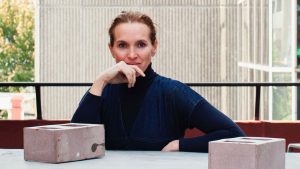
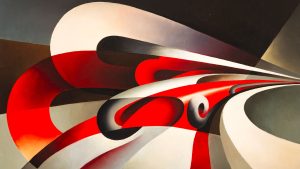
> Rosa Barba/ Agrigento 1972
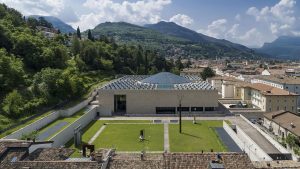
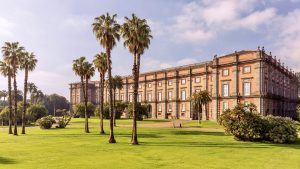
> Rossella Biscotti/ Molfetta 1978
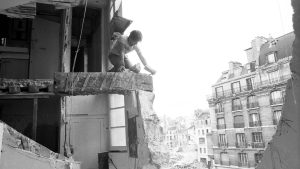
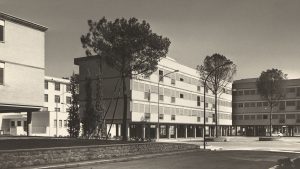
> Gianluca and Massimiliano De Serio/ Turin 1978
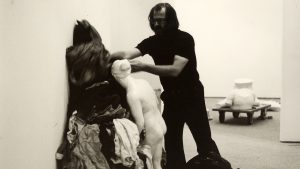
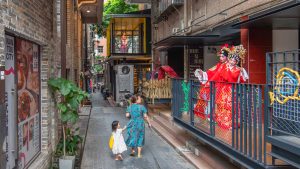
> Piero Golia/ Naples 1974
Rosa Barba

The Hidden Conference: about the discontinuous history of things we see and don’t see, 2010
9.30’, 35mm, optical sound
Private Tableaux, 2010
7’, 16mm, optical sound
Invisible Act, 2010
loop, 16mm, silver ball, celluloid
The Hidden Conference: about the discontinuous history of things we see and don’t see is born of a reflection made by Rosa Barba on the conservation of art works in the storage of various museum of modernist sculpture heritage. This is the first chapter of a larger investigation of cultural storages and archives. The artist witnesses a fictive conference of these artworks within their condition of silent coexistence with the spaces they are kept by turning the location into a Theatre-stage with a specific light choreography.
Private Tableaux takes its cues from the studies conducted over the years by the numerous professionals and engineers who have examined the stability of works of underground architecture. Using different drawings, realized by scientists for reasons of study, what emerges case-by-case are all of the deformations evident on the walls, in the end becoming the involuntary representation of a parallel story, whose dense diffusion of signs occupies the entire volume of the space.
Invisible Act is a sculptural installation bringing projected image and recollected language, material and imagined object, into an oppositional and conflating dialogue. The art works speculate on the nature of the document not just as is finalized but as the present tense of reflection – less an act of translation but the continual transposition of material into image and back again.
Courtesy the artist, Gallery Giò Marconi, Milano; Carlier Gebauer, Berlino
Rossella Biscotti

Il Processo, 2010-2011
audio installation, 8 hours, loop; reinforced concrete casts; performance in the Courtroom Bunker of Foro Italico, the former Corte d’Assise di Roma
The project by Rossella Biscotti originates with a research into the architectural spaces of the Foro Italico and political movements in Italy in 1970s. Biscotti is interested in the architectural and functional transformations of a number of historically famous sites. In this case, the fencing hall designed by Luigi Moretti, assumed as an emblem of this transformation – from a sports hall during the Fascist era to a courtroom-bunker for the some of the most important political trials of the 1970s and 80s. Taking her cues from the so-called “7 April” trial against numerous members of Autonomia Operaia, she creates a mise en scene of an archaeology of fragments: reinforced concrete casts of details of architectural superfetations (defendants’ cage, cells, microphones, security systems), transcriptions, recordings and re-enactments of trial in an audio installation in the stairwell. The piece is completed by a series of performances realized inside the former courtroom-bunker itself.
Gianluca and Massimiliano De Serio

Stanze, 2010
HD, 58’
Stanze is a sort of poetic sequence that takes inspiration from and gives a contemporary twist to oral tradition in Somalia, where poetry was used as an instrument of public and political debate. The film is the work of a number of young political refugees from Somalia, in what was their last “home” in Turin: the La Marmora barracks in Via Asti, which is an authentic centrifuge of Italian history. Built during the first period of Italian colonialism in the Horn of Africa, the barracks was used during the years of Fascism by the Republican National Guard, and became the place where Resistance fighters were tortured and executed. A number of Fascists who had worked in Via Asti were sentenced in the 1946 trial, but were able to take advantage of an amnesty. The barracks has now become a reception centre for Somali political refugees, who are the actors in Stanze. The contribution made by the writer and cultural mediator Suad Omar made it possible to start up a collective work in which each individual tells their own story, the uprooting forced upon them, and the inability of Italy to give refugees adequate reception. They gradually begin to act out excerpts from the 1946 trial, which have been recovered after considerable research work.
The film starts once every hour, beginning at 11:00 a.m., based on the Museum’s opening hours.
Credits: Photography and Camera Operator: Mario Amura; RED Assistant: Marco Pasini; Operator’s Assistant: Paolo Benitti, Gabriele Gallareto; Live Audio Recording: Daniele Turi and Alessio; Video Editing: Carlo Cagnasso Sound Design: minus (minusandplus.net); RED: Technovision Rome; Colour Correction: Marco Fantozzi. CAST: Suad Omar Sheikh Esahaq; Abdullahi Ahmed Abdullahi ; Adnan Mohamed Abdi; Abdulaziz Ali Hassan; Farhan Ahmed Mohamed; Ahmed Mohamud; Jinow Ahmed.
Piero Golia

Untitled (Carpet), 2002- 2006
spray paint
Oh my God That’s so Awesome (Monkey Picture), 2009
photo printed on PVC mesh
On the Edge (Sulla cresta dell’onda), 2000
palm tree
Piero Golia examines the theme of the relationship between the museum institution and the artist, between the space of exhibition and the work of art, between the visible and the invisible in an installation composed of three elements: a large arrow, situated on the roof of the building in front; a giant image of a monkey which was supposed to be installed on the façade of the apartment building visible through the great window and a palm tree in the square of the Museum. Each part of the installation refers to the other, in a circular dialogue that connects the work and its single aspects to Piero Golia’s artistic experience. The image of the monkey – conceived in a urban and architectural scale – is now forced to be inside the exhibition space. The three works directly confront themselves with the scale and the dimension of the museum, it’s indoor and outdoor spaces, between art and architecture. In an ideal itinerary through the last ten years of the artist’s career, represented by the three works exhibited, the project reflects on the museum function and on the institutionalisation of the work of art.
ph Sebastiano Luciano (part)











> Rosa Barba/ Agrigento 1972
> Rossella Biscotti/ Molfetta 1978
> Gianluca and Massimiliano De Serio/ Turin 1978
> Piero Golia/ Naples 1974
Rosa Barba
The Hidden Conference: about the discontinuous history of things we see and don’t see, 2010
9.30’, 35mm, optical sound
Private Tableaux, 2010
7’, 16mm, optical sound
Invisible Act, 2010
loop, 16mm, silver ball, celluloid
The Hidden Conference: about the discontinuous history of things we see and don’t see is born of a reflection made by Rosa Barba on the conservation of art works in the storage of various museum of modernist sculpture heritage. This is the first chapter of a larger investigation of cultural storages and archives. The artist witnesses a fictive conference of these artworks within their condition of silent coexistence with the spaces they are kept by turning the location into a Theatre-stage with a specific light choreography.
Private Tableaux takes its cues from the studies conducted over the years by the numerous professionals and engineers who have examined the stability of works of underground architecture. Using different drawings, realized by scientists for reasons of study, what emerges case-by-case are all of the deformations evident on the walls, in the end becoming the involuntary representation of a parallel story, whose dense diffusion of signs occupies the entire volume of the space.
Invisible Act is a sculptural installation bringing projected image and recollected language, material and imagined object, into an oppositional and conflating dialogue. The art works speculate on the nature of the document not just as is finalized but as the present tense of reflection – less an act of translation but the continual transposition of material into image and back again.
Courtesy the artist, Gallery Giò Marconi, Milano; Carlier Gebauer, Berlino
Rossella Biscotti
Il Processo, 2010-2011
audio installation, 8 hours, loop; reinforced concrete casts; performance in the Courtroom Bunker of Foro Italico, the former Corte d’Assise di Roma
The project by Rossella Biscotti originates with a research into the architectural spaces of the Foro Italico and political movements in Italy in 1970s. Biscotti is interested in the architectural and functional transformations of a number of historically famous sites. In this case, the fencing hall designed by Luigi Moretti, assumed as an emblem of this transformation – from a sports hall during the Fascist era to a courtroom-bunker for the some of the most important political trials of the 1970s and 80s. Taking her cues from the so-called “7 April” trial against numerous members of Autonomia Operaia, she creates a mise en scene of an archaeology of fragments: reinforced concrete casts of details of architectural superfetations (defendants’ cage, cells, microphones, security systems), transcriptions, recordings and re-enactments of trial in an audio installation in the stairwell. The piece is completed by a series of performances realized inside the former courtroom-bunker itself.
Gianluca and Massimiliano De Serio
Stanze, 2010
HD, 58’
Stanze is a sort of poetic sequence that takes inspiration from and gives a contemporary twist to oral tradition in Somalia, where poetry was used as an instrument of public and political debate. The film is the work of a number of young political refugees from Somalia, in what was their last “home” in Turin: the La Marmora barracks in Via Asti, which is an authentic centrifuge of Italian history. Built during the first period of Italian colonialism in the Horn of Africa, the barracks was used during the years of Fascism by the Republican National Guard, and became the place where Resistance fighters were tortured and executed. A number of Fascists who had worked in Via Asti were sentenced in the 1946 trial, but were able to take advantage of an amnesty. The barracks has now become a reception centre for Somali political refugees, who are the actors in Stanze. The contribution made by the writer and cultural mediator Suad Omar made it possible to start up a collective work in which each individual tells their own story, the uprooting forced upon them, and the inability of Italy to give refugees adequate reception. They gradually begin to act out excerpts from the 1946 trial, which have been recovered after considerable research work.
The film starts once every hour, beginning at 11:00 a.m., based on the Museum’s opening hours.
Credits: Photography and Camera Operator: Mario Amura; RED Assistant: Marco Pasini; Operator’s Assistant: Paolo Benitti, Gabriele Gallareto; Live Audio Recording: Daniele Turi and Alessio; Video Editing: Carlo Cagnasso Sound Design: minus (minusandplus.net); RED: Technovision Rome; Colour Correction: Marco Fantozzi. CAST: Suad Omar Sheikh Esahaq; Abdullahi Ahmed Abdullahi ; Adnan Mohamed Abdi; Abdulaziz Ali Hassan; Farhan Ahmed Mohamed; Ahmed Mohamud; Jinow Ahmed.
Piero Golia
Untitled (Carpet), 2002- 2006
spray paint
Oh my God That’s so Awesome (Monkey Picture), 2009
photo printed on PVC mesh
On the Edge (Sulla cresta dell’onda), 2000
palm tree
Piero Golia examines the theme of the relationship between the museum institution and the artist, between the space of exhibition and the work of art, between the visible and the invisible in an installation composed of three elements: a large arrow, situated on the roof of the building in front; a giant image of a monkey which was supposed to be installed on the façade of the apartment building visible through the great window and a palm tree in the square of the Museum. Each part of the installation refers to the other, in a circular dialogue that connects the work and its single aspects to Piero Golia’s artistic experience. The image of the monkey – conceived in a urban and architectural scale – is now forced to be inside the exhibition space. The three works directly confront themselves with the scale and the dimension of the museum, it’s indoor and outdoor spaces, between art and architecture. In an ideal itinerary through the last ten years of the artist’s career, represented by the three works exhibited, the project reflects on the museum function and on the institutionalisation of the work of art.
ph Sebastiano Luciano (part)